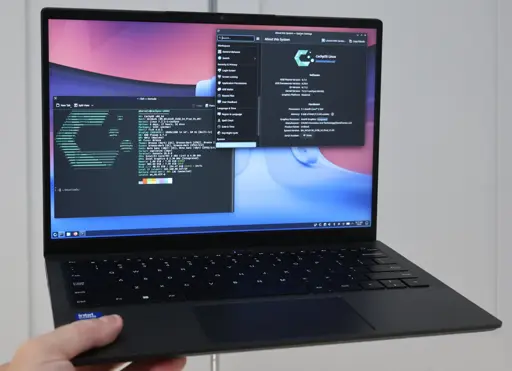
Often times when testing different Linux distributions or comparing Windows vs. Linux it’s on leading flagship desktop or server hardware, but today we are looking at the Ubuntu vs. CachyOS vs. Windows performance at the opposite end of the spectrum. With the new CHUWI UniBook $449 laptop powered by Intel Core 3 Wildcat Lake and with 8GB of system memory, here is a look at how those three operating systems compare across a variety of workloads.
I love the fact that these get benchmarked, but I wish that Phoronix made the difference between “lower is better” scores and “higher is better” scores much more apparent.
Maybe put a gradient on the bars so we can see which one is better at a glance.
Or change the “lower is better” layout so the bars are right aligned instead of left aligned.
Read your comment before checking out the graphs, thinking “how bad could it be?”. Turns out, very!
I wouldn’t have even noticed the Linux wins had I not remembered to look for the tiny indicator
My Plex server is running Fedora on a Sandy Bridge Intel chip. Would you like some benchmarks from that? Warning: it may catch fire… Lol.
All operating systems were updated and at their defaults during the benchmarking process.
So it’s really a KDE vs GNOME thing?
(ducks and runs)
Seriously, the article doesn’t say after 2 pages.
Anyhow, the results are as expected: both Linux distros definitely perform better than Win11, but between them there’s little difference.
🤷both Linux distros definitely perform better than Win11
Not exactly, at least the final results show that Windows 11 is in between both distributions:

I personally doesn’t care much about Windows and am surprised the gap between Ubuntu and Cachy is this big.
Long time Linux mint user. I switched to cachyos. I heard that cachy was faster but I wasn’t expecting much. But it really do feel snappier.
The big difference for me is battery life. I do virtual therapy so hour long video call fairly regularly. A video call would take me from 100% to ~20% battery on Linux mint. On cachyos its 100% to 50% battery. General use it lasts long but I don’t have numbers for that other than more.
I have similar laptop too. 8GB ram, but I think I have an i5.
Edit: KDE on cachyos. Linux mint cinnamon
I have an old laptop I just use in the mornings for web browsing. Was running Mint for the last year (first computer I switched form Windows) and it worked well, but was quite slow (same as when it was running Windows). Browsing was fine if the browser was left open, but opening any app took quite awhile.
Anyway, I run Cachy on all my other computers and after having a Mint issue figured I’d just swap it. It’s like a whole new laptop now, snappy and pretty instant for apps. Was quite surprised. Also the touch screen works, wasn’t expecting that.
I stand corrected then.
But I still don’t care. It’s not like any test result will make me go back to Microslop.
Agreed. Also these kind of tests are always weird, because its mostly default settings. While this makes sense in Windows, it only makes kind of sense in a Linux distribution, because as you said its actually more about stuff like the desktop environment. But at least, because it is default configuration, we know what it means and contains. I also don’t care about the results for Windows, just compare the Linux vs Linux stuff, that’s more interesting to me.
Seriously, the article doesn’t say after 2 pages.
it’s here, and yes it’s gnome vs kde but the different distro muddies the comparison.
I must say, the results are more varied than I expected.
There are several unrealistic issues with these tests which don’t reflect the real user’s experience:
-
It’s done in new installations. Windows tends to slow down over time unless you do some heavy maintenance. Linux doesn’t.
-
Most windows installations are bloated at purchase time (with the equipment). You need experience and time to debloat it. If you buy a computer with Linux preinstalled it is not bloated.
-
Most windows applications installations bloat the system even more. Apps tend to install extra stuff and add application autostart entries. Linux applications tend to only install the app.
-
Windows background processes slow down the system unless you do some special configurations to avoid it. Storage trashes for hours with the indexing, rebalancing, etc.
The counterpart is that
-
Other than a few examples, Linux doesn’t come preinstalled. And even then, for example, my ThinkPad came with Fedora preinstalled but it was a sloppy installation. The storage wasn’t encrypted and secure boot was disabled. I still had to start from scratch.
-
Linux requires less maintenance but what it needs, the user needs to do manually or automate. However, some Desktop environments have started to automate things like indexing and start behaving like windows, slowing the system at boot when is exactly when I want my computer to perform the best. That’s why I turn on my computer, right?
-