

5·
5 days agoFrom what I can tell, the issue with Wireguard is that the traffic is quite obvious. Other options might be blocked, but technically harder to implement said blocks.
From what I can tell, the issue with Wireguard is that the traffic is quite obvious. Other options might be blocked, but technically harder to implement said blocks.
Yeah, WG is by far the best way to do this kind of networking.
That’s quite fascinating, didn’t realize Wireguard could be blocked in that way (although the WG traffic is pretty obvious looking, so it makes sense). The only solution I know of without a need for a VPS is hosting everything on Tor. Wildly private and secure, but also wildly slow. Beyond that, there are a number of ways of using a VPS to similar effect, I know people have used Cloudflare Tunnel to similar effect in the past.
Also, there are apparently quite a number of wiregaurd derivatives which protect better against detection and blocking methods. amnezia and wstunnel are the two that came up. Likewise, you will need a VPS, and might even be able to set up a tailscale-like coordination server that way (maybe with headscale, or maybe with one of its competitors like NetBird).
ZeroTier might also get the job done, but I really don’t know much about it.
Hope this helps, and good lucks!
There’s a ton of suggestions and stuff already, so don’t want to add to the noise, but thanks for the work! Had no idea about Artix, and almost installed it because of dinit.
Just wanted to say, KaOS is systemd free, it’s been using dinit for the init system for some time now. It does ship with some standalone systemd components like elogind, but so does Chimera. (also a really good project if anyone wants to check it out, quickly becoming my go-to recommend).
Also check out Chimera Linux, it’s a brilliant project. The lead dev is trans, the package management philosophy is very similar to Void, but with Alpine’s APK instead of XBPS, and Dinit is a damn good init system. Here be dragons, but it remains one of my favorite distros.
Ronald is indescribably more important than any tech billionaire could ever hope to be. So let’s raise a glass and give out a hardy thank you to all the Ronalds of the world!
Also, the wing shape and nose shape. The 777 tapers in far more than the 757 around the cockpit. The 757 has a slightly different wing sweep and flap design. The 777 also doesn’t have winglets, and the 757 almost always does.
But yeah, for me the gear gave it away, it’s where I always start when IDing aircraft (assuming it’s extended, and not something super obvious like a 747).
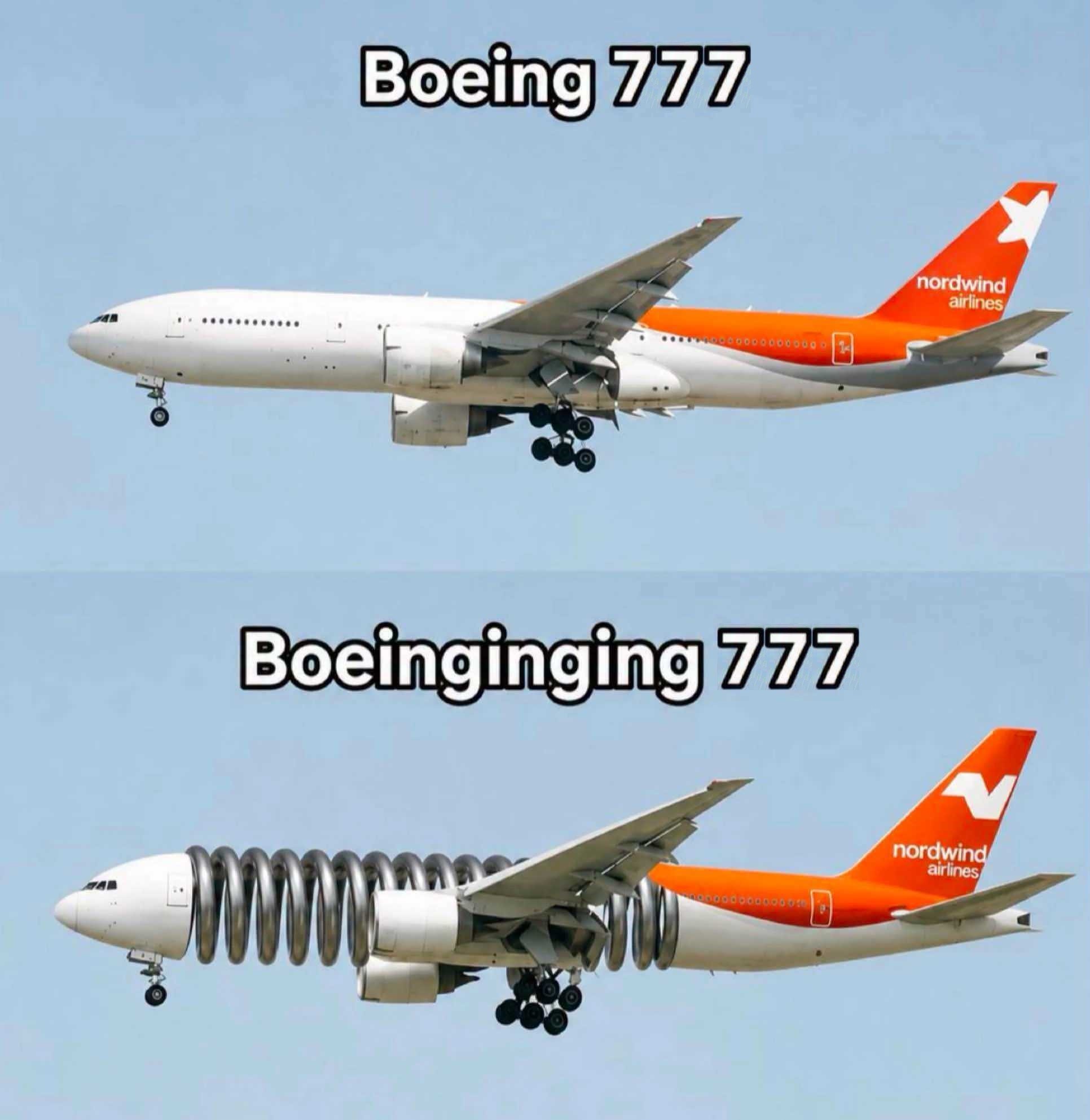
So glad to see I’m not the only one getting triggered by the fact the 777 is mislabeled as a 747. Saw it floating around today and it irked me every time… So anyway here’s an updated version someone else made.

Next year, I’m telling you, it’s going to be the year of the BSD desktop.
Yup, that sounds exactly like what I do.
Huh, the more you know. My only experience with ZSH is when I briefly used Manjaro, and it seemed fine at the time… but now that I say that I think about it, “Manjaro defaulting to it,” might have been a bit of a red flag…
Yeah, I agree. It’s quirky, its syntax is annoying, and a good ZSH setup is probably better… but I don’t have the time to do an actual ZSH setup.
There’s probably only two people who will get this joke… and I’m one of them.
Today I’m using Chimera, but KaOS, Arix or perhaps some unholy install of Alpine with DINIT are tempting me. Seems a persistent kernel panic on wake from sleep has been fixed, so I’m not super tempted to hop ATM.
I have used quite a number of “enthusiast” distros. Arch, Alpine, Void, NixOS, briefly Rawhide, others I am forgetting, and most recently Chimera. Arch is by far the simplest, easiest and stablest distro I have ever used, at least for what I want out of my computer.

I’m skeptical, but not against it. It’s not an existential threat to humanity as the general populous believes, but it’s also not a silver bullet. Assuming we as a society wish to create more electricity (which is a pretty massive assumption, but a story for another time), nuclear power is the most appealing and effective option. Kyle Hill on YouTube has explained this in great depth. However, the wast disposal is still mildly problematic and always will be. What’s more, the mining is certainly not a solved problem, and brings with it a reasonably high risk of contamination.
Perhaps if I knew a government agency trustworthier than the DOE (or US government as a whole) was involved, I would feel differently. However, I have seen how they have operated currently and historically first hand, and I don’t find their methods satisfactory.
Personally, I think the better method is reduction of energy consumption. When I worked for the DOE, I was told that utilities were bleeding money, and ready to go bankrupt because household appliances had reduced demand that much. So they lobbied for electric vehicles, which has strained the grid in some ways, but that’s a complicated story for another time. But as many of you already know, an EV is a highly ineffective means of reducing carbon emissions in the long-term. While more effective than gas, public transit, bicycles, and changes to infrastructure as the more effective means of reducing carbon emissions long-term.

What’s interesting is that this is far more an example of a social, rather than political, failing of our society. We can all agree that social media is harmful to everyone in many contexts, but can also provide a certain benefit in the sharing of knowledge, information, and ideas. How many of us had something of a queer awakening after being exposed it on social media? I sure as heck fall into that boat.
I once heard it equated to drinking, your taught from your parents what a responsible (or not) way of in taking alcohol is. Same with driving, same with work. In all these things were there is a fine balance of harm and benefit, we are taught be the older generation. But what if there is no older generation to teach us? Well, as is the case with certain indigenous communities in Alaska where no alcohol existed, you find yourself with no one being responsible. For the regulators, the obvious solution is an outright ban. But banning subsistence that are “bad” for you if addictive, never works. Prohibition, and the war on drugs are key examples of that.
We see this and scoff, because we are the ones who, though trial and error, found something approaching that balance. We see the harm is not in the social platforms themselves, but rather in the algorithmic monetization creating great psychological harm for everyone. We see that anyone using the internet is (more or less) a pseudonymous peer, and attempting to classify groups by geography and/or age is quite foolish. We also see the abuse and harm that attempting to do so would cause. Unfortunately, but rather predictably, the politicians are corrupt ass hats in the pocket of big-tech and invariably, make exceedingly stupid laws greatly to the detriment of the people. It is, therefore, of my opinion that the only reasonable solution is to get rid of them in their entirety Ⓐ.
Listened to a rather interesting episode of Darknet Diaries the other day about a European cyber crime group. To this day, the FBI has been unable to decrypt the devices. The feds didn’t give too many details about the specifics, but what they did share was quite interesting:
From what I gathered, I think the optimal balance of usability and security (especially for a headless machine) would be the following:
It is also very much worth noting, even though the FBI never got into the hackers’ computers, they had more than enough evidence to convict the lot. Being the defender of a computer system is always a losing battle.






I don’t want to be a naysayer or Luddite (wait, who am I kidding?), but I hard disagree with that take. A space economy will get us nowhere. Yeah, sure, some interesting technology (arguably) came from the Apollo program, and NASA has done some amazing astronomy with JWST and Hubble. But, as with so many other aspects of modern life, the cost is far too great to society as a whole. The energy needed to get anything to or from orbit is enormous, and there is no way around that. The thing we need to curb climate change is reduction of energy usage in any form (driving, flying, electricity, ect.). This is even on top of other issues in rocketry like ozone layer depletion and the light pollution described above. As such, if climate change really is the greatest threat to humanity (which it is), putting anything into space is not a worthwhile venture.