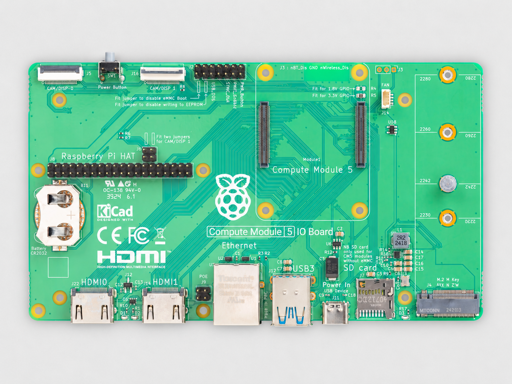

shittification of technology by the ai companies much less innovation much higher cost much higher inflation caused by ai NOT deflation as elon and trump promised by ai. more gas lighting more hot air. less and less productivity.
also raspberry pi is made for the DIY community else just buy a PC delusional doesn’t even know what their product is and was built for. my how the new culture are so far away from its roots after getting popular. this is why never ever let them become too big to not care about their core like all fang stonks and nvda google meta apple microsoft amazon all need to be canceled culturally. have no loyalty to any of them unless they give much better prices and product the answer is no and lower your prices.
EnshittyPi.
If you had read the article instead of just blindly reacting to the title you would have seen that this is actually to prevent that.
Nahh, their reasoning is BS IMO. It’s not an iPhone or something it’s a hobby product for tinkering with.
I read the article. Fuck Raspberry Pi.
Yes, they are claiming that this is to protect us, the consumers, by preventing us from buying unofficially upgraded boards that may be unreliable or use counterfeit parts on the secondhand market.
But here’s the fun part: That’s a lie. They just don’t want you upgrading your own hardware when you could pay them more instead.
It’s a hobbyist product. If you put “safeguards” in to block tinkerers, you’re dead to me.
The funniest thing about this is that Apple used the same excuse to defend parts locking. And every other company that limited the user’s right to repair and upgrade their purchased products.
It’s all BS. A company cares only about money, and they couldn’t care less about your product performing slightly less than optimally, if it ever does. Apple did it for profit, car manufacturers did it for profit, John Deere did it for profit and Raspberry Pi did it for profit.
There’s a bit of a difference in that your iPhone is (used to be) more likely to be swiped for parts (since the whole phone is unuseable, but the screen e.g is still worth a couple hundred) than anyone is to sell counterfeit raspberry pis for profit - and if anyone did do that, why’s that even a problem? I know someone who successfully upgraded a Macbook Air to 8 GB back when they had the 4 GB option and that was also soldered RAM. All for his personal use, but the thing continued working and it’s trivial to implement a check for original config by serial number.
I read the article, their ‘reasoning’ is bs
I bought the hardware, I as a consumer should be able to do whatever I want with it. If they were actually worried about resellers selling bad ram, they could have just left the detection in and warn the user of the modification instead of blocking it entirely.
Want to buy a bridge?
Google have an imei checker for their phones. Google.
You could check that it is real and active.
Raspberry pi could allow people to check their board model on their site to see if they are getting the right amount of RAM. They could devise a method to allow checking the correct RAM is attached and not a recovered stick off another board of the same size.

Is that BJ Blazcowicz?
They’ve completely lost the plot. Raspberry Pi was founded on the principle of hacking, education, and doing more with less. It’s their DNA, but now it’s clear all they give a shit about is money. They are corporate garbage now, like so many other organizations in the FOSS community that gave up freedom and openness for the Almighty dollar (or pound in this case).
Eben Upton can suck my soldering iron.
I knew it was happening the second they mentioned “IPO”. Company was cooked.
Are there any companies that make comparable products? I’ve been thinking of making a simple and small and low power media computer and I’d rather it not be a raspberry pi anymore
There’s a lot of good options, but for media you probably just want an x86 mini PC since they are way cheaper. Intel N100 based, or similar.
Orange Pi, Banana Pi, plenty of other Chinese SBC makers who products don’t necessarilly have names ending in Pi. Tons of those in places like Aliexpress. You can even try a Risk-V architecture if you’re daring.
The problem is that their english language support is inferior, as is the software stack, plus the ecosystem is a lot smaller so there’s a lot less info on those from other people out there. That said, as far as I can tell all of them have at least one Linux distro (at the very least ARMbian), some having more distros.
Still, it would be fine if all you want is a small computer with HDMI to turn it into a media player using Linux and something like Kodi.
Alternativelly, just get a Mini-PC with a low power intel chip like the N100 - which is actually cheaper than a Raspberri Pi 5 whilst being more powerful and with better peripheral compatibility since it has a PC architecture - and put the Linux with Kodi in it. Sure, it uses more power because it’s not ARM, but not actually that much more (15w vs 8w for a Pi, if I remember it correctly).
Raspberri Pi devices are maybe twice the price of other devices with equivalent hardware, which means that the low-end low-power Mini-PCs are cheaper and yet more powerful and compatible than the high end Pi.
I have a mini PC just like that at home working as a TV Media Player (which a nice remote control and everything) and I even use it as a home server and home nas (remotelly controlled via web interfaces and SSH) since it’s has far more power than needed for just being a media player.
Might be a controversial take, but Raspberry Pi’s are pure ass as media servers. They’re profoundly i/o limited, which extends to access to external USB devices as well as ethernet, and lack the oomph required to decode hi-res video streams locally. 1080p can be choppy, forget about 4K.
Pi5 occupies the unhappy spot where it’s too expensive for enthusiast and hobby applications, but inadequate as a desktop PC which benefit from a bit more power.
A mini-PC is a much better fit. An N100 might even be overkill - mine has a Skylake from a decade ago in it, and it crushes ‘media’ activities while gently sipping at electricity.
I thought media decoding was like the one thing they were decent at. But yeah, for everything else I’ve always ended up severely disappointed by their usability.
Well, I went for an N100 myself (and recommended it) because of its low power consumption (it has a 15W TDR), which makes it a good choice for an always on device which is how I operate my Mini-PC because it’s also my home NAS.
That range of CPUs was design to consumer less power and most x86 CPUs consumer significantly more power than this.
This. I switched from planning on a raspberry pi, to just getting a mini PC. It works as my main desktop now.
Also, limited support, both in community size and time. Those Chinese manufacturing companies come and go like docker containers. They spin one up to sell some product for a while, then when they’re done they dissolve it. If you want any support, you’re on your own.
It’s hard to imagine exactly what kind of person would want to build their own Linux media server but also actually needs to contact tech support for hardware they own outright.
Half the fun anyway is getting it to work at all, the other half is tweaking and getting it to work exactly the way you want.
I’m a $50-$100 “mystery Thinkpad from eBay” kind of guy. From what I gather, there are lots of us. Exactly zero times have I thought “oh but what if I need to contact Lenovo?” LMAO
I mean community support, as in the number of people using them and have experience, who know what works and what doesn’t.
Tech support in the sense of stuff like bios updates is important too.
Yeah, good point. The ability to download necessary firmware updates/patches from a safe, trusted source is easy to take for granted, but that shouldn’t be overlooked.
The makers of both Orange Pi and Banana Pi have been around for years, over a decade at least for Orange Pi.
In fact in my experience SBC makers tend to be quite stable, possibly because those thinks are a lot more technically complex than, say, an electric kettle.
look up wyse terminals or micro pcs in youtube.
This guy has a ton of videos on the subject. Entertaining and informative.
It’s been cheaper to buy a SFF desktop and not need dongles for everything
Asus NUC with Intel N150 is what I’ve been looking at. Up-board.org has a credit card sized dev board with the proc, if form factor is a requirement.
There is also the N350 with 8 cores for more power.
the measure is primarily intended to prevent third parties from buying lower-capacity boards, replacing their RAM with cheaper parts of uncertain origin and then reselling the modified hardware as a higher-capacity model. The company argues that such modified boards have not undergone its validation process and could subsequently generate support requests if unstable memory is blamed on the company.
The solution to this decidedly rare problem is authorized resellers, not an arbitrary block on a very technically demanding upgrade.
That’s assuming this is the actual problem though. If the problem is actually “We want to make more money by charging extra for ‘enthusiast models’” then this is the correct tactic to ensure that you aren’t undercut by cheap labor.
Their excuse definitely smells like bullshit. It just seems they want to do the Apple thing of making sure they get the money for the upgrade, plus a premium. Except even Apple has a technical reason they don’t allow upgrades, which Raspberry Pi doesn’t.
Raspberry pi is public. They have a clear profit motive behind the upsell. Clear as day.
Nah it’s not technical reasons, it’s just greed and form over function, the new MacBook new proves that if Apple wanted to they can make a user repairable and even upgradable laptop, they don’t because the EU hasn’t forced them yet
How does the new MacBook prove that? The way their processors are made it’s impossible to upgrade RAM after the fact.
From a consumer freedom standpoint this is shitty. And it does allow them to sell an enthusiast model at a premium without competing with an after market modder.
But two things can be true. I don’t think it’s entirely unreasonable for the company to want to protect the integrity of the brand if unreliable after market sellers start releasing bad product indistinguishable from your own with your logo slapped on it.
Even if you have authorized resellers entrusted with doing the upgrades and audited for quality, if you leave the door open, there will be unauthorized mods on the market too. It does hurt not only Raspberry Pi, but the entire resell market if you can’t trust the product to have their expected standard of quality. It still sucks, but I at least get the justification.
A few years back, I worked in an assembly plant for a car company. One time when I was doing a quality containment, I found out that something like 30-50 cars were found to have a very slightly misaligned roof piece when it was welded, and it causes a slight, but visible warp in the roof. It was otherwise fine. Still water proof, still structurally sound, just a cosmetic defect. They were all quarantined to be stripped of any easily removable components and then the remaining parts and body would be scrapped.
I asked why? Even if they didn’t want to put them out to dealers with a visible defect, they were still safe and functional. They could still offer them to employees for sale at a discount and make far more back for them than its value as scrap. The answer was that it could hurt the value of the brand as a whole if low quality cars were put on the market, even if only for resale. It was worth the loss of these 30+ cars to maintain a consumer’s high expectation of quality.
I still think it may have been better to allow employees an opportunity to get a new vehicle at a great price with only a cosmetic defect. But I do get the competing concern there. You do want things you buy from a big company to have reliable quality.
I get the sentiment, but this is a computer’s active component. If they can detect that the RAM is non-stock, they can just have the UEFI say that in POST. Problem solved with about the same amount of code as their current “solution”.
The fact that there are multiple solutions to the problem they say they’re trying to solve, but they chose one that is both anti-consumer and protective of their upcharged models makes it obvious what their real intentions are. Follow the money and it will lead you to the truth nearly always. In your example, the car company was willing to lose money.
Fair.
They already have authorized resellers, who they link to on their website. This problem would only come from unauthorized resellers, who would not qualify for warranty service. It might not help software support requests, but I don’t know how much support they offer for software since I don’t think they’re supplied with any. Anything hardware they should be asking for a receipt from an authorized reseller, and if the customer can’t provide it then it’s not covered by the warranty. And even if the customer can provide a receipt from an authorized reseller in their name, if it comes in for repair and has the wrong RAM then it’s not a warranty repair anyway (although I’m guessing for something this inexpensive they don’t repair individual units, they probably just send a replacement, so the counterfeit parts might not get noticed).
One consideration is that the community support would not like the fallout of shady 3rd party manufacturers/resellers putting out faulty hardware either.
Yeah load of bullshit

Yeah, it sure is. It’s a hobbyist product and they took away my ability to upgrade it. After 14 years of buying these boards, they decided now, during a global RAM shortage, to tighten the leash…
I can solder new RAM into my MacBook or Nvidia GPU, but Raspberry Pi is the first to implement physical locks preventing RAM upgrades. What a fucking joke.
I can solder new RAM into my MacBook or Nvidia GPU
You still have to extract and modify the bios to recognize and address the new ram in those cases, you can’t just “drop in” more ram.
That’s what’s being locked down, here. Raspberry Pi devices used to not care if you did so because the firmware was open.
I personally know someone who installed extra RAM on a Macbook Air at least, didn’t require modifying any firmware IIRC. It just detected it. Not sure how GPUs are these days, though.
So if you take a macbook air with soldered-on ram, which was available in 2 configurations of 16GB and 32GB, those two configs are baked into the bios, you just need the correct density, speed, and CAS latency to go from 16 to 32.
But if you stray from what’s in the firmware/bios, you’ll need to figure out how to get the ram recognized so it can be used.
In a raspberry pi, the known configs are in the firmware, so resellers were taking cheap low-ram pis, replacing the ram with double-density and selling them for a big markup from their cost, but lower than a retail RPI.
The new policy would force these resellers to mod the bios to keep doing it.
might as well just buy a normal laptop(or something used) then or smth if i decide this restriction is not fine,
also RPI5 8gb ram for 150~ usd alone is not worth it anymore, 80 usd was fine.Probably cheaper to buy a laptop than a smith.
true

I feel like raspberry has been backstabbing everyone for a while.
Enshitification will continue until morale improves
Another win for mini PCs. Pis priced themselves out of the market since pi4-pi5 imo
I can get a second hand mini pc or Optiplex for much cheaper, and with quick sync
yep and I/O isn’t terrible to add. A CP2112 USB <–> I2C module is like $5 on amazon (and way less on AliExpress) and gets you an I2C port and a few GPIO all controllable through Python or libusb. The FT232H or CH347 modules are similar and offer SPI as well.
This makes sense. Hear me out.
-
A CM5 is a device designed to be embedded into other devices. I believe most of their sales come from just that- companies that make other things, and build a CM5 into them rather than design their own control board.
-
As you go up through the model tiers, the price increases faster than the added price of memory. IE, if the 2gb one is $20, and the difference between a 2gb memory chip and an 8gb memory chip is $10, the 8gb unit isn’t $30 it’s $60. You pay RPi a premium for the high end products.
-
Desoldering RAM off a production PCB is something no hobbyist is going to bother with. BUT, a company buying 10,000 of these to build into their product MIGHT find it cost effective to setup a production line to do so. And they could probably resell the 2gb chips.
Point being- while I don’t like this, and I don’t like the ideas it represents, I also understand why they are doing it. It’s not about us, the hobbyists. It’s about the manufacturers that build compute modules into their products.
What’s the problem with a company doing what they want with hardware they purchased and own?
In concept nothing. But do you also recognize a legitimate business model of selling multiple products at different price points, spaced out more than the different cost of production?
And speaking hypothetically with some stupid numbers is it your argument that they should be able to purchase the $20 product, add $10 of parts, and either use it or sell it as the $200 product?
In concept nothing. But do you also recognize a legitimate business model of selling multiple products at different price points, spaced out more than the different cost of production?
Yes of course, but if the spacing is too much then stuff like this starts to happen.
is it your argument that they should be able to purchase the $20 product, add $10 of parts, and either use it or sell it as the $200 product?
Yes, once I buy something it’s mine to do with as I want. Obviously warranty may be void in some cases, but otherwise I own it.
If the market exists that is willing to buy it as a $200 product then Raspberry Pi should sell them for that price, their costs would be much lower than someone who buys a Pi at retail, buys new RAM chips, spends the time to desolder and solder on the new RAM chips, market their ‘product’, and deal with shipping it. If the knockoff is $200 and the same-spec legitimate Pi with warranty is $200, the knockoff won’t be around for long.
The fact that it is economically viable to resolder different chips, is already showing it’s a illegitimate business model, imo…
Not a product, but a money grab
enshitification always makes sense. Hear me out.
- Company needs to make more money
The Raspberry Pi Foundation is governed by a Board of Trustees that is responsible for ensuring that we use our resources effectively to achieve our charitable goals.
It seems the Trustees can’t be trusted
But it’s a foundation, with a charitable goal…
So they are a company but also a foundation.
How?
Clever accounting, one entity invoices the other and whatnot. One entity could be the reseller for the goods the other one is producing for example. Similar arrangements (no need for a foundation, just invoicing between your own entities) like that are often done e.g to pay your taxes in a lower rate jurisdiction than where you earn your money. You could set up a company that sells stuff and another company to hold the IP and then pay royalties. Etc.
ClosedAI is looking to do something similar, go from non-profit to for-profit. Personally I’m of the opinion that such a thing should warrant investigations and possibly indictments for fraud. Because it IS fraud, or at least false advertising. If I buy a Raspberry Pi, knowing that it’s a foundation with a good cause, and the next day they announce they’re starting a for-profit company to handle everything, that’s very much false advertising, as the foundation model was be one of the factors in choosing which product to buy. If that makes sense.
Yes, companies need to make money. It’s kind of what they do.
Yeah just like cancer needs to spread and grow. It’s just what cancer does. It does make sense.
But, never the less, we’re still going to cut the cancer out someday.
Either that, or the cancer will end up killing us.
And, curiously, kill itself in the process.
We sure are, comrade, we sure are.
Desoldering RAM off a production PCB is something no hobbyist is going to bother with
Ever heard of “repair” when no original spare parts are available?
According to the article you can still do this. It’s just you can’t replace a 2 GB with an 8 GB because the board will still only recognize 2GB of that chip.
This is to prevent the resellers from buying 2 GB boards for cheap, replacing them with cheap 8 GB chips, and then reselling them for just under retail of the official 8 GB boards.
The article also states that you likely can’t use just any compatible chip, the part number is baked into the board, so you might not even be able to swap out a 2GB SK Hynix with a 2GB Samsung chip
it does not say part number is baked in. it says parameters are baked in (latencies, frequency), and so chips with a different part number might not work.
-
So do we own the pi that we bought or does Raspberry Pi?
There’s a blob in there you will never own
First time?
/j
Srs, I don’t think I’ve ever owned a consumer device that, as the other person points out, didn’t have blobs inside from the factory. Sure, ive manually replaced the BIOS with Libreboot and switched to blobless (software) WiFi chips, but then what about the EC blobs? The keyboard and mouse? If being fully FOSS predicates ownership, I don’t think any of us own our devices
How does LibreBoot work? Was it hard to set up?
It’s a coreboot distribution (FOSS BIOS/UEFI), so technically it works on more things than advertised.
To install it it does require a little bit of preparation. There’s a lot of commands you have to run using a custom compiler toolchain to build an image for your board. The hardest part is disassembling the laptop, if you have an older one, which is mostly what Libreboot targets.
It doesn’t work in most things fyi
The behaviour is particularly interesting because physically replacing the memory on a Raspberry Pi is already well outside the scope of an ordinary upgrade.
I mean… aren’t hackers the target audience for Raspberry Pis?
Yeah, if the reasoning they give isn’t just straight bullshit, then I guess I don’t want to see them drown in support tickets. But it also seems like this move runs pretty counter to the whole point of the Raspberry Pi.
(Plus, can’t resellers buy 2GB models, redo some of the screen printing, and sell them as 8GB models without even trying to upgrade the RAM to 8GB? That seems at least as bad as getting a Raspberry Pi with a dodgy 8GB RAM chip.)
I mean… aren’t hackers the target audience for Raspberry Pis?
They used to be. But for the last few years it has looked less and less like that.
Hey man I just push the buttons to make the green text happy; I don’t build ‘em
Pis are extremely popular for home labs, they can be used in tons of different ways.
For what it’s worth the original point of the Pi was to recreate the experience of the Commodore 64 or BBC Micro where they came with huge manuals with ample examples and were more or less bare hardware for cheap. Taking that metaphor all the way is how we got the 400 and 500.