- cross-posted to:
- programmerhumor@lemmy.ml
- cross-posted to:
- programmerhumor@lemmy.ml
You must log in or register to comment.
Describing what they want in plain, human language is impossible for stakeholders.
‘I want you to make me a Facebook-killer app with agentive AI and blockchains. Why is that so hard for you code monkeys to understand?’
You forgot we run on fritos, tab, and mountain dew.
Maybe he want to write damn login page himself.
Not say it out loud. Not stupid… Just proud.
Even writing an RFC for a mildly complicated feature to mostly describe it takes so many words and communication with stakeholders that it can be a full time job. Imagine an entire app.
Getting ai to do a complex problem correctly takes so much detailed explanation, it’s quicker to do it myself
While it’s possible to see gains in complex problems through brute force, learning more about prompt engineering is a powerful way to save time, money, tokens and frustration.
I see a lot of people saying, “I tried it and it didn’t work,” but have they read the guides or just jumped right in?
For example, if you haven’t read the claude code guide, you might have never setup mcp servers or taken advantage of slash commands.
Your CLAUDE.md might be trash, and maybe you’re using @file wrong and blowing tokens or biasing your context wrong.
LLMs context windows can only scale so far before you start seeing diminishing returns, especially if the model or tools is compacting it.
- Plan first, using planning modes to help you, decomposition the plan
- Have the model keep track of important context externally (like in markdown files with checkboxes) so the model can recover when the context gets fucked up
https://www.promptingguide.ai/
https://www.anthropic.com/engineering/claude-code-best-practices
There are community guides that take this even further, but these are some starting references I found very valuable.
So even more work than actual coding.
Yup. It’s insanity that this is not immediately obvious to every software engineer. I think we have some implicit tendency to assume we can make any tool work for us, no matter how bad.
Sometimes, the tool is simply bad and not worth using.
Everyone is a senior engineer with an idiot intern now.
That’s not all! It’s also less rewarding!
Early adopters will be rewarded by having better methodology by the time the tooling catches up.
Too busy trying to dunk on me than understand that you have some really helpful tools already.
While you’re right that it’s a new technology and not everyone is using it right, if it requires all of that setup and infrastructure to work then are we sure it provides a material benefit. Most projects never get that kind of attention at all, to require it for AI integration means that currently it may be more work than it’s worth.
This is why I say some people are going to lose their jobs to engineers using AI correctly, lol.
“If I need to write boilerplate and learn a new skill, is it really worth it?”
My point was the investment in vs the value out may not be worth it for many projects. Beyond that, it may not be maintainable for all projects (at least with how fast things have been changing in this space and the heavy reliance on 3rd party systems to make it work).
It’s professional development of an emerging technology. You’d rather bury your head in the sand and say it’s not useful?
The reason not to take it seriously is to reinforce a world view instead of looking at how experts in the field are leveraging it, or having discourse regarding the pitfalls you have encountered.
The Marketing AI hype cycle did the technology an injustice, but that doesn’t mean the technology isn’t useful to accelerate determistic processes.
You want the answer to the ultimate question of life, the universe, and everything? Ok np
LLMs need to be trained to work with reptilian language. Problem solved.
The canonical video which demonstrates that truth.
You can add SQL in the 70s. It was created to be human readable so business people could write sql queries themselves without programmers.
Ironically, one of the universal things I’ve noticed in programmers (myself included) is that newbie coders always go through a phase of thinking “why am I writing SQL? I’ll write a set of classes to write the SQL for me!” resulting in a massively overcomplicated mess that is a hundred times harder to use (and maintain) than a simple SQL statement would be. The most hilarious example of this I ever saw was when I took over a young colleague’s code base and found two classes named “OR.cs” and “AND.cs”. All they did was take a String as a parameter, append " OR " or " AND " to it, and return it as the output. Very forward-thinking, in case the meanings of “OR” and “AND” were ever to change in future versions of SQL.
Object Relational Mapping can be helpful when dealing with larger codebases/complex databases for simply creating a more programmatic way of interacting with your data.
I can’t say it is always worth it, nor does it always make things simpler, but it can help.
I don’t have a lot of experience with projects that use ORMs, but from what I’ve seen it’s usually not worth it. They tend to make developers lazy and create things where every query fetches half the database when they only need one or two columns from a single row.
Yeah. Unless your data model is dead simple, you will end up not only needing to know this additional framework, but also how databases and SQL work to unfuck the inevitable problems.
deleted by creator
the problem with ORM is that some people go all in on it and ignore pure SQL completely.
In reality ORM only works well for somewhat simple queries and structures, but at some times you will have to write your own queries in SQL. But then you have some bonus complexity, that comes from 2 different things filling the same niche. It’s still worth it, but there is no free cake.
I’ve always seen as that as a scapehatch for one of the most typical issues with ORMs, like the the N+1 problem, but I never fully bought it as a real solution.
Mainly because in large projects this gets abused (turns out none or little of the SQL has a companion test) and one of the most oversold benefits of ORMs (the possibility of “easily” refactor the model) goes away.
Since SQL is code and should be tested like any other code, I rather ditch the whole ORM thing and go SQL from the beginning. It may be annoying for simple queries but induces better habits.
I used to use ORMs because they made switching between local dev DBs ( like SQLLite, or Postgres) and production DBs usually painless. Especially for Ruby/Sinatra/Rails since we were writing the model queries in another abstraction. It meant we didn’t have to think as much about joins and all that stuff. Until the performance went to shit and you had to work out why.
My standard for an orm is that if it’s doing something wrong or I need to do something special that it’s trivial to move it aside and either use plain SQL or it’s SQL generator myself.
In production code, plain SQL strings are a concern for me since they’re subject to the whole array of human errors and vulnerabilities.
Something like
stmt = select(users).where(users.c.name == 'somename')is basically as flexible as the string, but it’s not going to forget a quote or neglect to use SQL escaping or parametrize the query.And sometimes you just need it to get out of the way because your query is reaaaaaal weird, although at that point a view you wrap with the orm might be better.
If you’ve done things right though, most of the time you’ll be doing simple primary key lookups and joins with a few filters at most.
I did that myself back in the day. Not overly complicated, but a SQL builder.
I think it’s because SQL is sort-of awkward. For basic uses you can take a SQL query string and substitute some parameters in that string. But, that one query isn’t going to cover all your use cases. So, then you have at least 2 queries which are fairly similar but not similar enough that it makes sense just to do string substitutions. Two strings that are fairly similar but distinct suggests that you should refactor it. But, maybe you only make a very simple query builder. Then you have 5 queries and your query builder doesn’t quite cover the latest version, so you refactor it again.
But, instead of creating a whole query builder, it’s often better to have a lot of SQL repetition in the codebase. It looks ugly, but it’s probably much more maintainable.
What part of this is irony?
So is COBOL.
(Is there any sane alternative to SQL?)
(Is there any sane alternative to SQL?)
Yes, no SQL.
I lol’d
AWK?
(Is there any sane alternative to SQL?)
Well there is our lord and savior, or so I’m told by many MBA(s), No SQL
Oh wait you said Sane. Nevermind.
By that logic could we say the same about compilers.
Or anything above assembly.
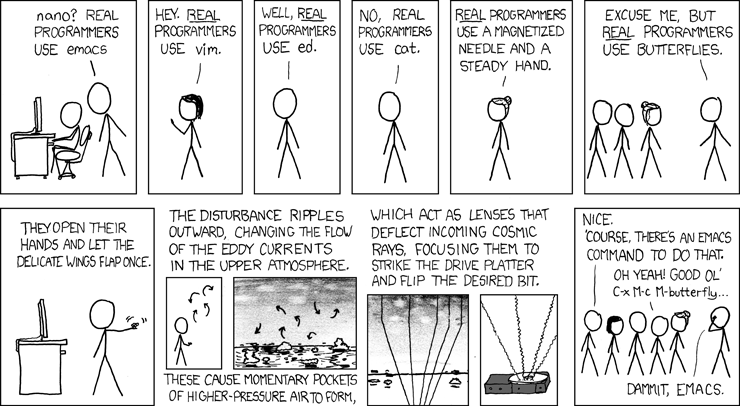
Real programmers use punchcards.
Least it’s an improvement over no/low code. You can dig in and unfuck some ai code easily enough but god help you if your no code platform has a bug that only their support team can fix. Not to mention the vendor lock in and licensing costs that come with it.
Doesn’t matter if they can replace coders. If CEOs think it can, it will.
And now, it’s good enough to look like it works so the CEO can just push the problem down the road and get an instant stock inflation
And then it’ll all go to shit and proper programmers will be able to charge bank to sort it out.
I don’t want so spend my career un-fucking vibe code.
I want to create something fun and nice. If I wanted to clean other people’s mess, I would be a janitor.
If I wanted to clean other people’s mess, I would be a janitor.
I’ll take your share of the slop cleanup if you don’t want it. I wouldn’t mind twice the slop cleanup
extortionsalary.Cleaning other people’s mess is okay for a while. But making a career out of it is too much for me.
I do firmware for embedded systems and every mechanical, electronics or general engineering issue is shoved down in my court because it’s easier for people to take shortcuts in the engineering process and say “we’ll fix it in the firmware” since I can change code 100 times a day.
Slop is the embodiment of that on steroids and it will get old pretty fast.
Cleaning other people’s mess is okay for a while. But making a career out of it is too much for me.
Oh yes. I feel that, too. I’ll give them maybe a year of help, for the right price. Two years if the price is very right. Haha.
Slop is the embodiment of that on steroids and it will get old pretty fast.
So true.
I hope it works like that.
I hope all those companies go bankrupt, people hiring those CEOs lose everything, and the CEOs never manage to find another job in their lives…
But that’s a not bad second option.
The CEOs will get a short term boost to profits and stock price. Theyll get a massive bonus from it. Then in a few years when shit starts blowing up, they will retire before that happens with a nice compensation package, leaving the company, employeez, and stockholders up shits creek from his short sighted plan.
But the CEO will be just fine on his yacht, dont worry.
C-Suite execs are probably the one thing LLMs could actually replace and save the company more money than layoffs, but it’ll never happen.
Companies aren’t democracies. They are monarchies with the illusion of democracy via shareholders.
It already does, there are people selling their services to unfuck projects that were built with generated code.
Hell yeah. Those people are smart. I hope they get super rich on fixing AI nonsense.
They’ll end up being exploited
What do you think happens already lmao
What’s your point?
I don’t think this will lead to any additional exploitation as that’s already the general business model.
That’s the point I was making
It never actually seems to work out that way though. Sure, for Y2K there was a short period where there were decent contracts fixing that bug in various codebases, but it wasn’t something that lasted very long.
Managers and owners would much rather pass off a terrible PoS and have their users deal with it, or somehow get the government to bail them out, or hire a bunch of Uyghur programmers from a Chinese labour camp, or figure out some other way to avoid having to pay programmers / software engineers what they’re actually worth.
LLMs often fail at the simplest tasks. Just this week I had it fail multiple times where the solution ended up being incredibly simple and yet it couldn’t figure it out. LLMs also seem to „think“ any problem can be solved with more code, thereby making the project much harder to maintain.
LLMs won’t replace programmers anytime soon but I can see sketchy companies taking programming projects by scamming their clients through selling them work generated by LLMs. I‘ve heard multiple accounts of this already happening and similar things happened with no code solutions before.
Today I removed some functions and moved some code to separate services and being the lazy guy I am, I told it to update the tests so they no longer fail. The idiot pretty much undid my changes and updated the code to something very much resembling the original version which I was refactoring. And the fucker did it twice, even with explicit instructions to not do it.
I have heard of agents deleting tests or rewriting them to be useless like ‘assert(true)’.
Your anecdote is not helpful without seeing the inputs, prompts and outputs. What you’re describing sounds like not using the correct model, providing good context or tools with a reasoning model that can intelligently populate context for you.
My own anecdotes:
In two years we have gone from copy/pasting 50-100 line patches out of ChatGPT, to having agent enabled IDEs help me greenfield full stack projects, or maintain existing ones.
Our product delivery has been accelerated while delivering the same quality standards verified by our internal best practices we’ve our codified with determistic checks in CI pipelines.
The power come from planning correctly. We’re in the realm of context engineering now, and learning to leverage the right models with the right tools in the right workflow.
Most novice users have the misconception that you can tell it to “bake a cake” and get the cake ypu had in your mind. The reality is that baking a cake can be broken down into a recipe with steps that can be validated. You as the human-in-the-loop can guide it to bake your vision, or design your agent in such a way that it can infer more information about the cake you desire.
I don’t place a power drill on the table and say “build a shelf,” expecting it to happen, but marketing of AI has people believing they can.
Instead, you give an intern a power drill with a step-by-step plan with all the components and on-the-job training available on demand.
If you’re already good at the SDLC, you are rewarded. Some programmers aren’t good a project management, and will find this transition difficult.
You won’t lose your job to AI, but you will lose your job to the human using AI correctly. This isn’t speculation either, we’re also seeing workforce reduction supplemented by Senior Developers leveraging AI.
I seriously doubt your quality is maintained when an LLM writes most of your code, unless a human audits every line and understands what and why it is doing it.
If you break the tasks small enough that you can do this each step, it is no longer writing a full application, it’s writing small snippets, and you’re code-pairing with it.
We have human code review and our backlog has been well curated prior to AI. Strongly definitely acceptance criteria, good application architecture, unit tests with 100% coverage, are just a few ways we keep things on the rails.
I don’t see what the idea of paircoding has to do with this. Never did I claim I’m one shotting agents.
Great? Business is making money. I already explained we have human reviewed PRs on top of full test coverage and other validations.
We’re compliant on security policies at our organization, and we have no trouble maintaining what the current code we’re generating because it’s based on years of well defined patterns and best practices that we score internally across the entirety of engineering at our organization.
As more examples in the real world:
Aider has written 7% of its own code (outdated, now 70%) | aider https://aider.chat/2024/05/24/self-assembly.html
https://aider.chat/HISTORY.html
LibreChat is largely contributed to by Claude Code, it’s the current best open source ChatGPT client, and they’ve just been acquired by ClickHouse.
https://clickhouse.com/blog/clickhouse-acquires-librechat
https://github.com/danny-avila/LibreChat/commits/main/
Such suffering from the quality! So much worse than our legacy monolith!
Your product is an LLM tool written with LLM tools. That’s is hilarious.
If the goal is to see how much middleware you can sell idiots, you’re doing great!
Incorrect, but okay.
This entire comment reads like lightly edited ai slop.
Well, I typed it with my fingers.
Which IDEs?
Cursor and Claude Code are currently top tier.
GitHub Copilot is catching up, and at a $20/mo price point, it is one of the best ways to get started. Microsoft is slow rolling some of the delivery of features, because they can just steal the ideas from other projects that do it first. VScode also has extensions worth looking at: Cline and RooCode
Claude Code is better than just using Claude in cursor or copilot. Claude Code has next level magic that dispells some of the myths being propagated here about “ai bad at thing” because of the strong default prompts and validation they have built into it. You can say dumb human ignorant shit, and it will implicitly do a better job than others tools you give the same commands to.
To REALLY utilize claude code YOU MUST configure mcp tools… context7 is a critical one that avoids one of those footguns, “the model was trained on older versions of these libraries.”
Cursor hosts models with their own secret sauce that improves their behavior. They hardforked VSCode to make a deeper integrated experience.
Avoid antigravity (google) and Kiro (Amazon). They don’t offer enough value over the others right now.
If you already have an openai account, codex is worth trying, it’s like Claude Code, but not as good.
JetBrains… not worth it for me.
Aider is an honorable mention.
Codex is not bad. I use it for personal projects and Claude at work, so I can directly compare and Codex seems better to me.
In my opinon, Codex is fine, but copilot has better support across AI providers (mode models), and Claude is a better developer.
Thanks!
Sure thing, crazy how anti AI lemmy users are!
One of the rare comments here that is not acid spewing rage against AI. I too went from “copying a few lines to save some time” and having to recheck everything to several hundred lines working out of the box.
deleted by creator
I get it. I was a huge skeptic 2 years ago, and I think that’s part of the reason my company asked me to join our emerging AI team as an Individual Contributor. I didn’t understand why I’d want a shitty junior dev doing a bad job… but the tools, the methodology, the gains… they all started to get better.
I’m now leading that team, and we’re not only doing accelerated development, we’re building products with AI that have received positive feedback from our internal customers, with a launch of our first external AI product going live in Q1.
What are your plans when these AI companies collapse, or start charging the actual costs of these services?
Because right now, you’re paying just a tiny fraction of what it costs to run these services. And these AI companies are burning billions to try to find a way to make this all profitable.
These tools are mostly determistic applications following the same methodology we’ve used for years in the industry. The development cycle has been accelerated. We are decoupled from specific LLM providers by using LiteLLM, prompt management, and abstractions in our application.
Losing a hosted LLM provider means we prox6 litellm to something out without changing contracts with our applications.
What are your plans when the Internet stops existing or is made illegal (same result)? Or when…
They are not going away. LLMs are already ubiquitous, there is not only one company.
Ok, so you’re completely delusional.
The current business model is unsustainable. For LLMs to be profitable, they will have to become many times more expensive.
What are you even trying to say? You have no idea what these products are, but you think they are going to fail?
Our company does market research and test pilots with customers, we aren’t just devs operating in a bubble pushing AI.
We are listening and responding to customer needs and investing in areas that drive revenue using this technology sparingly.

Get back to us when you actually launch and maintain a product for a few months then. Because you don’t have anything in production then.
We use a layered architecture following best practices and have guardrails, observability and evaluations of the AI processes. We have pilot programs and internal SMEs doing thorough testing before launch. It’s modeled after the internal programs we’ve had success with.
We are doing this very responsibly, and deliver a product our customers are asking for, with the tools to help calibrate minor things based on analytics.
We take data governance and security compliance seriously.
If you have all this infrastructure in place, similar internal programs and so on, why don’t you just adjust an internal program that you already have? What value does the AI actually offer?
Accelerated delivery. We use it for intelligent verifiable code generation. It’s the same work the senior dev was going to complete anyway, but now they cut out a lot of mundane time intensive parts.
We still have design discussions that drive the backlog items the developers work off with their AI, we don’t just assign backlog items to bots.
We have not let loose the SaaS agents that blindly pull from the backlog and open PRs, but we are exploring it carefully with older projects that only require maintenance.
And yes, we also use chore bots that are determinstic for maintainance, but these are more small changes the business needs.
There are in fact changes these agents can make well.
I don’t get how an MDA would translate to “no programmers needed”. Maybe they meant “coders”?
But really, I feel like the people who use this phrase to pitch their product either don’t know how many people actually find it difficult to break down tasks into logical components, such that a computer would be able to use, or they’re lying.Software engineering is a mindset, a way of doing something while thinking forward (and I don’t mean just scalability), at least if you want it done with quality. Today you can’t vibe code but proofs of concept, prototypes that are in no way ready for production.
I don’t see current LLMs overcoming this soon. It appears that they’ve reached their limits without achieving general AI, which is what truly would obsolete programmers, and humans in general.
Yeah why is it always coders that are supposed to be replaced and not a whole slew of other jobs where a wrong colon won’t break the whole system?
Like management or C-Suits. Fuck I’d take chatgpt as a manager any day.
programmers, and humans in general
With current levels of technology, they would require humans for maintenance.
Not because they don’t have self-replication, because they can just make that if they have a proper intelligence, but because their energy costs are too high and can’t fill AI all the way.
OK, so I didn’t think enough. They might just end up making robots with expert systems, to do the maintenance work which would require not wasting resources on “intelligence”.
Explicit programmers are needed because the general public has failed to learn programming. Hiding the complexity behind nice interfaces makes it actually more difficult to understand programming.
This comes all from programmers using programs to abstract programming away.
What if the 2030s change the approach and use AI to teach everybody how to program?
Hiding the complexity behind nice interfaces makes it actually more difficult to understand programming.
This is a very important point, that most of my colleagues with OOP background seem to miss. They build a bunch of abstractions and then say it’s easy, because we have one liner in calling code, pretending that the rest of the code doesn’t exist. Oh yes, it certainly exists! And needs to be maintained, too.
I find this to be a real problem with visual shaders. I know how certain mathematical formulas affect an input, but instead of just pressing the Enter key and writing it down, I now have to move blocks around, and oh no, they were nicely logically aligned, now one block is covering another block, oh noo, what a mess and the auto sort thing messes up the logical sorting completly… well too bad.
And I find that most solutions on the internet utilizing the visual editor tend to forget that previous outputs can be reused. Getting normals from already generated noise without resampling somehow becomes arcane knowledge.
Edit: words.
the general public has failed to learn programming
That’s like saying that the general public has failed to learn surgery, or the general public has failed to learn chemical engineering.
There are certain things that it just doesn’t make sense for the general public to ever be expected to learn.
People bake and learn basic chemistry. The baseline of general programming knowledge could be more than zero. It’s a fundamental part of our society.
Baking is not chemical engineering. Chemical engineering doesn’t even have much to do with chemistry. It’s mostly about temperatures and flow rates, pressure, etc.
Saying “the baseline of programming knowledge could be more than zero” is meaningless. The baseline of chemical engineering knowledge could also be more than zero. It’s also a fundamental part of our society. But, the average person doesn’t need to know how to program, just like the average person doesn’t need to know how to design a refinery.
People do learn some basic computer skills. They should learn more. They should know about files. They should know how to back up their data. And, more importantly, they should learn how to restore data from a backup after something goes wrong. They should know how to properly update their devices, how to tell if their devices are infected, and the basics of managing a home network. They sometimes learn how to do basic functions in excel spreadsheets. That’s about as far as they do, or should need to go in programming / IT. Beyond that, why should the average person need to know how to do recursion, or how loops work?
It gives them the opportunity to create their own tools.
Sure, and learning surgery could let them do their own operations.
deleted by creator
I I I I IV IV I I V IV I IV
deleted by creator
So, I can tell you what I know from a bassist’s PoV.
What I posted was the 12 bar blues chord progression in Roman Numeral notation. What it tells you is that if you start in the key of C, the other bars are 4 and 5 notes up from C. In addition, since the notation is in uppercase, the chords / arpeggios you can play in that bar are major not minor. So, if a bassist is playing a walking bass line for 12 bar blues, they’ll probably start those bars with C, F and G. But, since they’re C major, F major and G major, the bassist can play major arpeggios in that key in those bars and it will sound good.
For other kinds of blues progressions, if you know Radiohead’s “Creep”, you can see that as being an 8 bar blues with the following progression:
1 2 3 4 I III IV iv I vi ii V7 So if the root is C, the 2nd bar is E major, third bar is F major, 4th bar is F minor, and so on. Because the 3rd and 4th bars are both rooted at F the bassist can just play an F there and it sounds good (which is what I think Radiohead’s bassist does), but if the bassist chooses to play more notes in an apeggio, they have to play notes from the F-minor scale in that 4th bar or it doesn’t match.
As for why those various chord progressions happen to work, that I don’t know. I don’t know if anybody does. But, I do know there’s some math / physics behind it. A perfect fifth is one of the most pleasant sounding intervals, and those notes are at a frequency ratio of 2:3. The only better sounding thing is an octave at 1:2. And, the inverse of a perfect fifth is a perfect fourth. So, songs being made from 4ths, 5ths and octaves makes sense.
deleted by creator
What if the 2030s change the approach and use AI to teach everybody how to program?
What does AI (already known to be an unreliable bullshitting machine) provide to students that existing tutorials, videos and teachers do not already?
Also the companies investing in AI are not trying to teach their workers to be better, they’re trying to make more profit by replacing workers or artificially increasing their outputs. Teaching people to program is not what they care about
I’m afraid I cant let you do that, Dave.
You’ve not read the manual.
When growing up in the 70’s “computer programmers” were assumed to be geniuses. Nowadays they are maybe one tier above fast food workers. What a world!
Nowadays they are maybe one tier above fast food workers.
:-/
Having worked both jobs, I could point to a few differences
Yeah fast food is a lot more stressful.
Every single job in my entire life I have made more money, and my workload has gotten easier. I am grateful everyday I escaped the trap. Very few do.
Food is essential, the new shiny way to gobble more RAM to display a blue mushroom in a button isn’t.
Well to be fair if you’re a programmer in the 70s you might as well be a genius.
That environment was wild though. At the time, you basically needed to be an electrical engineer and/or a licensed HAM operator, just to have your head wrapped around how it all worked. Familiarity with the very electronics of the thing, even modifying the hardware directly when needed, was crucial to operating that old tech.
The most consistent and highest paying jobs I’ve had are replacing or fixing legacy and garbage systems. I don’t think the current gen llm’s are anywhere close to being able to do those jobs, and is in fact causing those jobs to have more work the more insecure, inefficient trash they generate.
Fellow tech-trash-disposal-engineer here. I’ve made a killing on replacing corporate anti-patterns. My career features such hits and old-time classics like:
- email as workflow
- email as version control
- email as project management
- email as literally anything other than email
- excel as an relational database
- excel as project management
- help, our wiki is out of control
- U-drive as a multi-user collaboration solution
- The CEO’s nephew wrote this 8 years ago and we can’t get rid of it
In all of these cases, there were always better answers that maybe just cost a little bit more. AI will absolutely cause some players to train-wreck their business, all to save a buck, and we’ll all be there to help clean up. Count on it.
excel as an relational database
That reminds me of a story. I used to do IT consulting, years ago. One client was running their 5 person real estate office off a low quality, consumer grade, box store HP desktop repurposed as a server. All collaboration was through their U drive, plus every profile had their desktop folder redirected there.
The complaint was the classic “everything is slow”, which turned out to be “opening my spreadsheet takes 10 minutes then it’s slow”. Yeah, because that poor little “server” had a single 100 Mb jack and the owner had a 1.5 GB excel spreadsheet project where he was trying to build a relational database and property valuation tool. Six fucking heavily cross referenced tabs, some with thousands of entries. He was so proud when I asked him to explain what was going on there. He fired me when I couldn’t fix his issue without massive changes to either his excel abomination or hardware.
Hey, kudos for finding multiple anti-patterns all in one place like that. I didn’t even think about “underpowered desktop as company server” as another pattern, but here we are.
Sorry you didn’t get the contract, but that sounds like a blessing in disguise to be honest.
It depends on the methodology. If you’re trying to do a direct port. You’re probably approaching it wrong.
What matters to the business most is data, your business objects and business logic make the business money.
If you focus on those parts and port portions at a time, you can substantially lower your tech debt and improve developer experiences, by generating greenfield code which you can verify, that follows modern best practices for your organization.
One of the main reasons many users are complaining about quality of code edited my agents comes down to the current naive tooling. Most using sloppy find/replace techniques with regex and user tools. As AI tooling improves, we are seeing agents given more IDE-like tools with intimate knowledge of your codebase using things like code indexing and ASTs. Look into Serena, for example.
Give it a few months.
If only this wasn’t becoming the agenda of big corporations…they are dropping jobs left and right and it’s scary. Robots will be doing most of our jobs sooner than later…lookup flippy bot we won’t even have entry level jobs soon and the problem is we’re not doing this to become more like star trek. They are doing this to add seventeen more marble gold diamond pillars to their dogs puppies houses on their 9000 acre private islands.
I’m still waiting to be replaced by robots and computers.
My company recently acquired another firm that tried to outsource the entire IT department and proceeded to shit itself to death.
Go ahead cowards. Replace me with a computer. I will become more powerful than you could ever imagine.
Feeling that. My company is off shoring and out sourcing a lot of stuff now. It’s a nightmare. But profits are up. So hey, who cares if the software is held together with hopes and dreams. And our hosted services admins don’t have a clue.
This is why I half ass things with AI. Mgmt clearly doesn’t care.
If ChatGPT’s browser is just another chromium clone and they couldn’t get their own AI to write a browser, I doubt other customers of theirs will get their shitbot to write code for them either.
Building apps without using code is still programming, since you must create logic for the program.
And after each of these, there’s been _more _ demand for developers.
Literally nothing of consequence has been built with visual, mda or no-code paradigms.
Well let me tell you, the things built in the vibe-cpdong paradigm will have consequences
You’re D:\ has been deleted. I’m very sorry.
Well, not mine, I can tell you that. And I’m not about to give an AI write permissions for /mnt