Gender neutral pronouns are just so much more convenient; I tend to use them even when I know someone’s gender. I do wish English had some common-use ones that were explicitly singular, though.
i think there is alot to be said about the influence of patriarchy on masculine words becomming applied to everyone. men being seen as the norm and all that…
I do wish English had some common-use ones that were explicitly singular, though.
In the long run I predict that “they” will follow the same path as “you” - it’ll become increasingly more associated with the singular, until it’s the default interpretation. I also predict that both “they” and “you” will eventually require a pluraliser to convey the plural.
“Vos” (you, singular) in Rioplatense Spanish followed a similar path.
If that’s correct, eventually there’ll be explicitly singular second and third person pronouns.


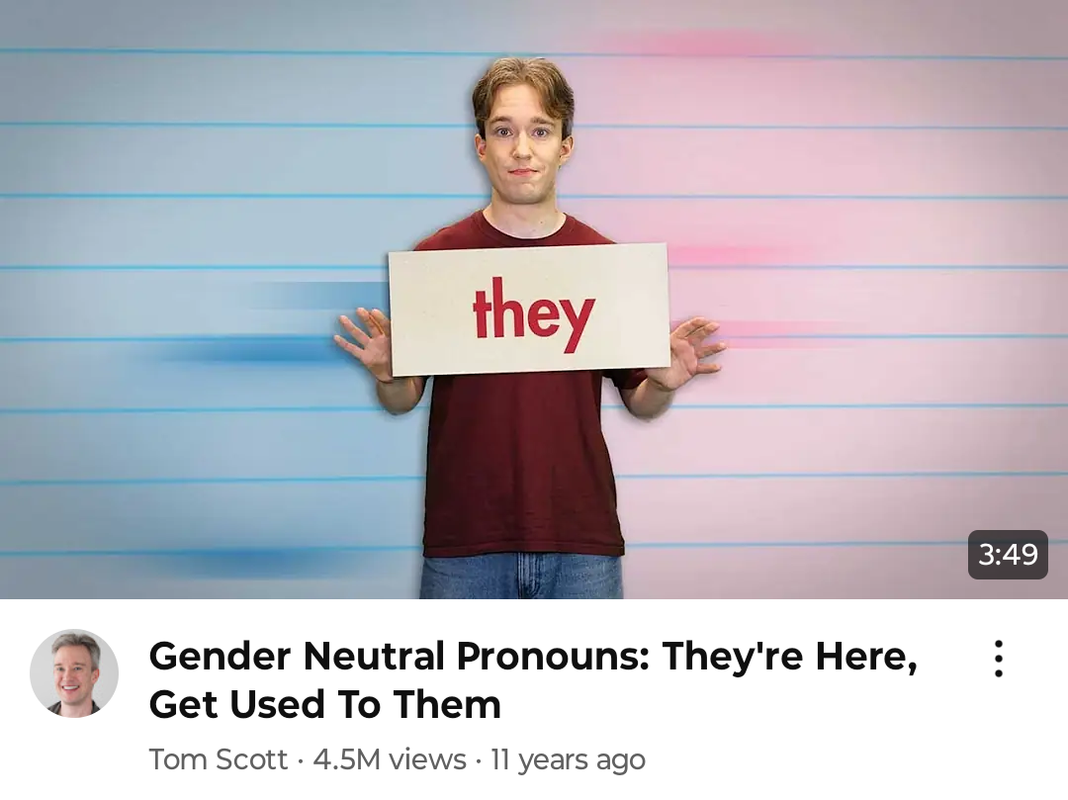
Gender neutral pronouns are just so much more convenient; I tend to use them even when I know someone’s gender. I do wish English had some common-use ones that were explicitly singular, though.
Dude is supposed to be gender neutral and singular.
Still, maybe don’t. Not everyone agrees with the gender neutrality of “dude”. How many dudes have you slept with?
i think there is alot to be said about the influence of patriarchy on masculine words becomming applied to everyone. men being seen as the norm and all that…
bhdbhisdbhisdbhji
In the long run I predict that “they” will follow the same path as “you” - it’ll become increasingly more associated with the singular, until it’s the default interpretation. I also predict that both “they” and “you” will eventually require a pluraliser to convey the plural.
“Vos” (you, singular) in Rioplatense Spanish followed a similar path.
If that’s correct, eventually there’ll be explicitly singular second and third person pronouns.
Do we currently have an explicit pluralizer for they?
We can thank Harry for this one
(TV;DW: them’ll)